Category Archives: Societal Values

Why do many men not do inner emotional work?

Many men do not engage in inner emotional work primarily due to early socialization, societal pressure to conform to traditional masculinity, and an ingrained fear of vulnerability. This behavior, often referred to as normative male alexithymia—the inability to identify or describe emotions—leads many men to suppress feelings, which they learn to view as signs of weakness or liabilities

Society also doesn’t help as it could by offering Rites of Passage to facilitate the transition from childhood through adolescence to adulthood where the young man finds inner resources he did not know he had.

Here are the key factors contributing to this trend: (the bit below is AI generated but ok)

1. Socialization and “Toughness” Conditioning 

  • Suppression from Childhood: Boys are often socialized from a young age to “man up,” stop crying, and hide their emotions. This teaches them that expressing vulnerability is unacceptable.
  • Killing the Emotional Self: As bell hooks highlighted in The Will to Change, patriarchal systems often force males to kill off their emotional selves to conform to expectations of being providers or protectors.
  • Fear of Shame: Many men fear that admitting to emotional struggles is a form of failure or weakness, which leads them to suffer in silence rather than seek help. 

2. Lack of Emotional Literacy and Tools 

  • Alexithymia: Men may not possess the vocabulary or capacity to identify what they are feeling, often experiencing emotional numbness or confusion.
  • Action over Words: Many men are trained to bond through shared activities (“shoulder-to-shoulder”) rather than conversation (“face-to-face”), meaning they lack experience in navigating emotional dialogue.
  • Conflict Avoidance: Men may have learned that expressing emotions results in conflict, leading to a “freeze or flee” response where they shut down or distance themselves emotionally. 

3. Fear of Consequences (Weaponized Vulnerability)

  • Punishment for Vulnerability: When men do open up, their emotional expressions are sometimes met with judgment, contempt, or betrayal by partners or peers.
  • Threat to Identity: Emotional expression can feel destabilizing to a man’s identity, causing fears that they will lose credibility or respect. 

4. Psychological and Protective Mechanisms

  • Trauma Response: Unresolved trauma or early childhood experiences with emotionally unavailable caregivers can lead men to shut down as a survival mechanism.
  • Covert Depression and Numbness: Many men experience depression not as sadness, but as irritability, anger, or numbness, which they try to manage through workaholism or addiction rather than emotional introspection. 

5. Differing Emotional Regulation Styles

  • Action-Oriented Regulation: Men often tend to regulate emotions through actions (problem-solving, physical activity) rather than verbalizing feelings.
  • Internalized Pressure: Men may feel that they need to be in “full control” of their emotions, viewing any loss of control as a failure of their role. 

These factors create a cycle where men are socialized to avoid emotions, lack the tools to understand them, and fear the consequences of revealing them, resulting in a persistent lack of inner emotional wor

The Elders have left the Village…

..and we hardly noticed their departure.

This exodus wasn’t marked by ceremony or collective grief—it happened gradually, invisibly, as the perfect century-long storm of wars and progress transformed the landscape of ageing in the West into some kind of an endless summer for the soul. The result? We’ve inherited a cultural wound so profound that many of us approaching our autumn years can scarcely recognise it, let alone name it.

Disrupted Lineage

Stephen Jenkinson names this wound precisely: we’re facing not just a crisis of elderhood, but its near-complete annexation by a culture of age without ageing, retirement without ripening. The post-war generation, our Baby Boomers, inherited a fractured lineage. Their own elders, shaped by depression and war trauma, often carried a stoic silence that masked deeper developmental arrests. These were men and women who survived by compartmentalising, by pushing forward, by refusing to look back—a psychological strategy that served them in crisis but failed to nurture the soul-making necessary for true elderhood.

Difficulty in Accepting Transitions of Aging

James Hollis reminds us that this developmental crisis stems from our culture’s profound misunderstanding of life’s second half. We’ve created a society that promises endless youth, endless consumption, endless distraction—anything to avoid the necessary descent into what Richard Rohr calls the “second simplicity.” Sharon Blackie suggests this avoidance manifests differently yet devastatingly across genders—while men flee from the confrontation with mortality, women are often denied even the cultural space to age authentically, pressured instead to maintain a perpetual spring in defiance of their autumn wisdom. This has produced what might be history’s first elderless generation: the Boomers, caught between their traumatised parents and their own unmetabolised youth, never witnessed genuine elderhood in action. Instead, they saw retirement—that peculiar modern invention that transforms the autumn and winter season of life into an extended adolescence, complete with its focus on leisure, consumption, and self-referential pleasures.

Lost Connection to our Earth

The consequences of this developmental vacuum are far-reaching. Bill Plotkin’s work reveals how this absence of authentic elderhood has ruptured our relationship with the very planet which our souls are soul of, creating generations of developmentally arrested adults who mistake financial security and environmental dominance for psychological maturity and progress. We’ve lost the ecological consciousness that traditionally emerged through the ripening process of genuine elderhood, replacing it with what Jenkinson calls “elderly idealism”—a state of perpetual youth-mindedness that refuses the gravitational pull toward genuine maturity.

A Wound and an Invitation

For those of us now crossing the threshold into life’s autumn season, this inheritance is both a wound and an invitation. We stand at a crucial developmental crossroads: we can either perpetuate the pattern of arrested development that has characterised recent generations, or we can choose a more challenging path—one that requires us to rebuild and reimagine elderhood and the very practice of eldering. This is no small task, because like most of those born in the 20th century, we must learn to elder without elders.

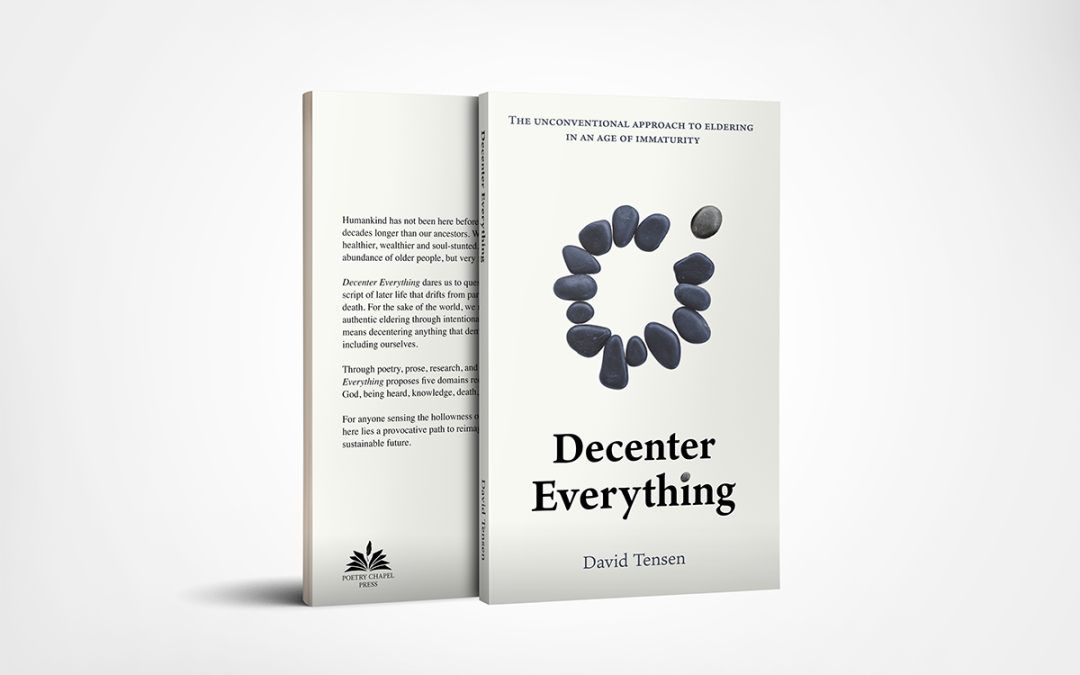
Courtesy of David Tensen from his book “Decentre Everything….The Unconvential Approach to Eldering in an Age of Immaturity”

Learn about yourself with other Men

Mens Counselling/Help/Sharing/Therapeutic Group starting September 2022 Mondays Headington PM. Lasting for 90 minutes this is a chance to listen, talk, observe, share, feel, be, express. Let’s see what subjects emerge between us. Facilitated by Guy Turton. Interaction between us will be encouraged. It will NOT be 1 to 1 counselling with a lot of people watching you. Please contact HERE for further information and HERE to contact me

Searching for the Anti-Virus | Covid 19 as a Quantum Phenomenon

Thought provoking article by Martin Winiecki…part of which is below

“I’ve struggled to make sense of what is going on. My suspicious mind wandered around restlessly, examining all theories and possible explanations, yet I must admit: I don’t know what is happening. I do know this is a crucial moment of choice for humanity. In this essay, I will not suggest or discuss “what is going on.” I rather want to invite you into a realm transcending the dichotomy of “objective reality” vs “subjective thoughts/feelings,” which underlies most theories, predictions and calls to action in this crisis. Coming from a spiritually-informed holistic worldview, I entertain the possibility that we as humanity – or some deeper part of ourselves, whether conscious or not – have dreamed this moment into existence as a catalyst for our collective evolution. If that were true, how might we engage and respond? Covid-19 could actually present an unlikely possibility for collective awakening and far-reaching system change

Early years support sets a child up for life. It should be a national priority

Guardian Article: In these precarious times, we need something even more ambitious than Sure Start

“What we need, to ensure the mental and physical health of future generations, is something far more radical and far-reaching than Sure Start – nothing less than a revolution in public policy on the early years. We need parenting classes for girls and – crucially – boys built in to the education system; and psychological support for all new parents, to stop damaging patterns being repeated”

Being vs Doing

Western society values Doing much more than Being.

Article from ‘The Ascent’ goes into this in more detail

Doing can be measured, can be seen by others, and can often me monetised

Being is hard to measure, is less visible and often doesn’t generate money

Doing can have a function of blocking out or avoiding or making it harder to tune into our deeper wisdom, intuition, perception and feelings.

This is an example of something that can be explored in Counselling for some people

‘I thought I was a lost cause’: how therapy is failing people of colour

Black and minority ethnic people are more likely to develop mental health conditions but less likely to access counselling – or find it fit for purpose. Are more BME therapists the answer?

I think the interventions and views taken by the therapists in this article are flawed. They were not being led by the clients experience but were trying to impose their own views, which is a mistake.

Long Term Offenders have different brain structure

Guardian Article explains ” Parents should not worry about their teenagers’ delinquent behaviour provided they were well behaved in their earlier childhood”

“……. adults who had a long history of offending showed a smaller surface area in many regions of the brain compared with those with a clean track record. They also had thinner grey matter in regions linked to regulation of emotions, motivation and control of behaviour – aspects of behaviour they are known to have struggled with….”

Passing Wisdom through generations

How good are we at passing between generations our learning though experience ?

We are great at documenting and passing material, scientific, technical, and factual information between generations. Year on year more discoveries are made and progress is made as a body of wisdom is generated…..

Or is it?

How good are we at passing between generations our learning though experience, our learning about things that can’t be measured….things like

-Feelings, Thoughts, Intuition, Perception….our Psychology or

-Experience in Relationship, Marriage, Choices, Life, Vulnerability, Daring to tell someone how we feel, taking a risk, opening our hearts?

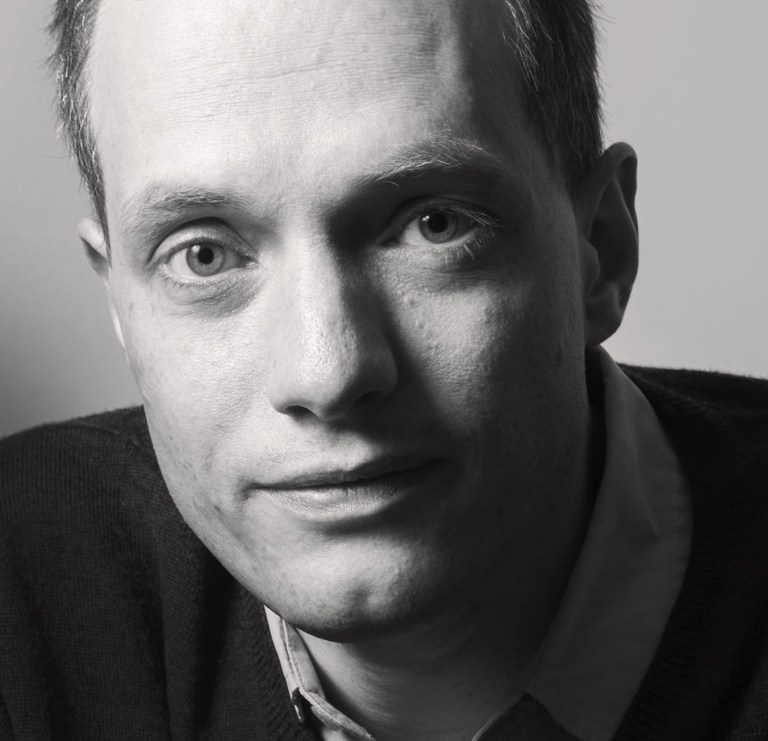
Alain De Botton in this article likens this absence of sharing of the latter things to being similar to asking each generation to discover the Laws of Physics for themselves…..How crazy would that be?

Passing wisdom through Generations
Alain De Botton, Why are we so selective about sharing our learning?

Counselling can be one way to learn the type of Wisdom that is harder to measure and harder to pass from one generation to another

If you’d like to organise a first session please click here